
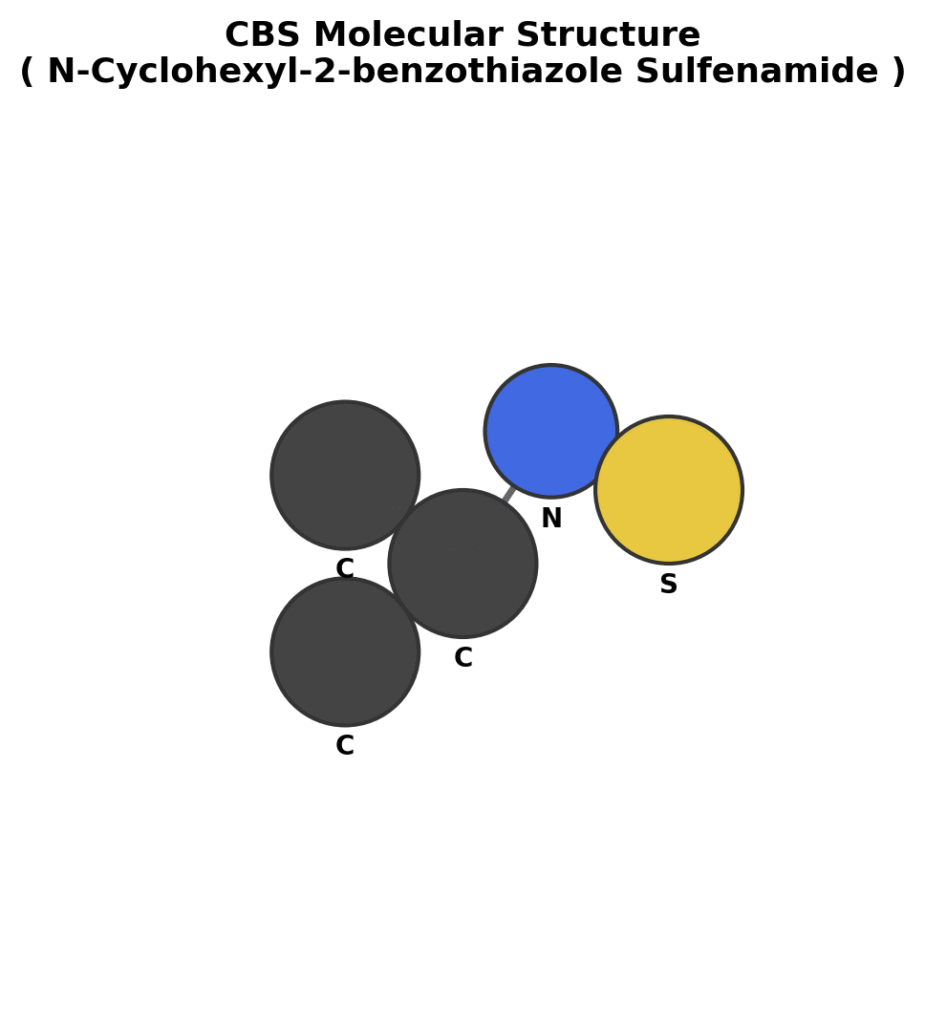

CBS Rubber Accelerator: The Complete 2026 Guide to N-Cyclohexyl-2-Benzothiazole Sulfenamide
CBS (N-Cyclohexyl-2-benzothiazole Sulfenamide) is a delayed-action, fast-curing primary accelerator in the sulfenamide class, widely used in tire manufacturing, industrial rubber goods, and conveyor belts. It offers an excellent balance of scorch safety and cure rate, making it the most popular sulfenamide accelerator in the global rubber industry.
What is CBS?
CBS stands for N-Cyclohexyl-2-benzothiazole Sulfenamide. It is a sulfenamide-type rubber accelerator known for its delayed action — it provides a long induction period before the cure begins, followed by a fast cross-linking reaction. This unique behavior gives CBS excellent processing safety while maintaining high productivity.
CBS is the most widely used sulfenamide accelerator globally, particularly in tire manufacturing.
Common names:
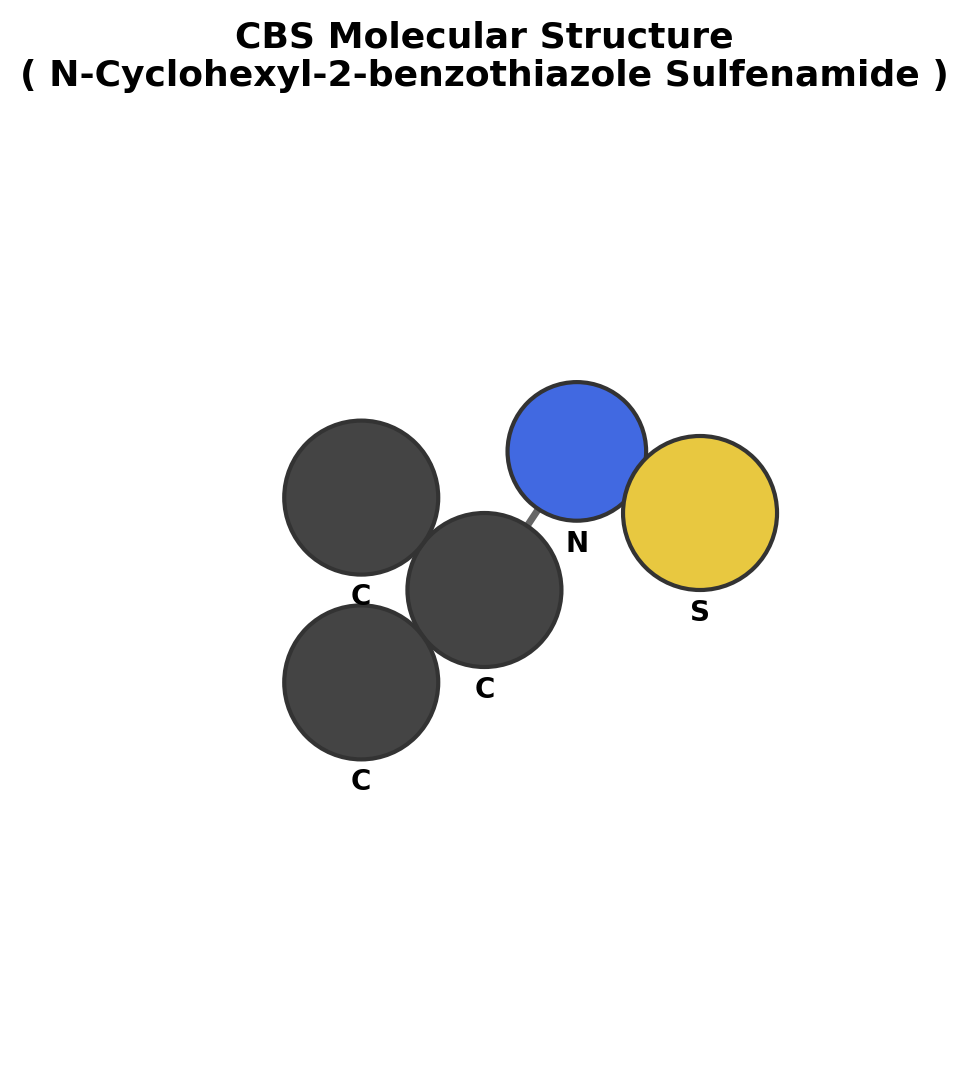
CBS, N-Cyclohexyl-2-benzothiazole Sulfenamide, Cyclohexylbenzothiazole sulfenamide, CBTS
Quick Facts
| Property | Value |
|---|---|
| Chemical Name | N-Cyclohexyl-2-benzothiazole Sulfenamide |
| CAS Number | 95-33-0 |
| Molecular Formula | C₁₃H₁₆N₂S₂ |
| Molecular Weight | 264.41 g/mol |
| Appearance | White to light gray powder or granules |
| Melting Point | 95–102°C |
| HS Code | 2934.20 |
| EINECS Number | 202-411-2 |
What is CBS Used For?
CBS is primarily used as a primary accelerator in sulfur vulcanization, with its dominant application being tire manufacturing. It accounts for approximately 40% of all sulfenamide accelerator consumption worldwide.
Primary Applications
| Industry | Product Examples | Typical CBS Loading (phr) | Key Benefit |
|---|---|---|---|
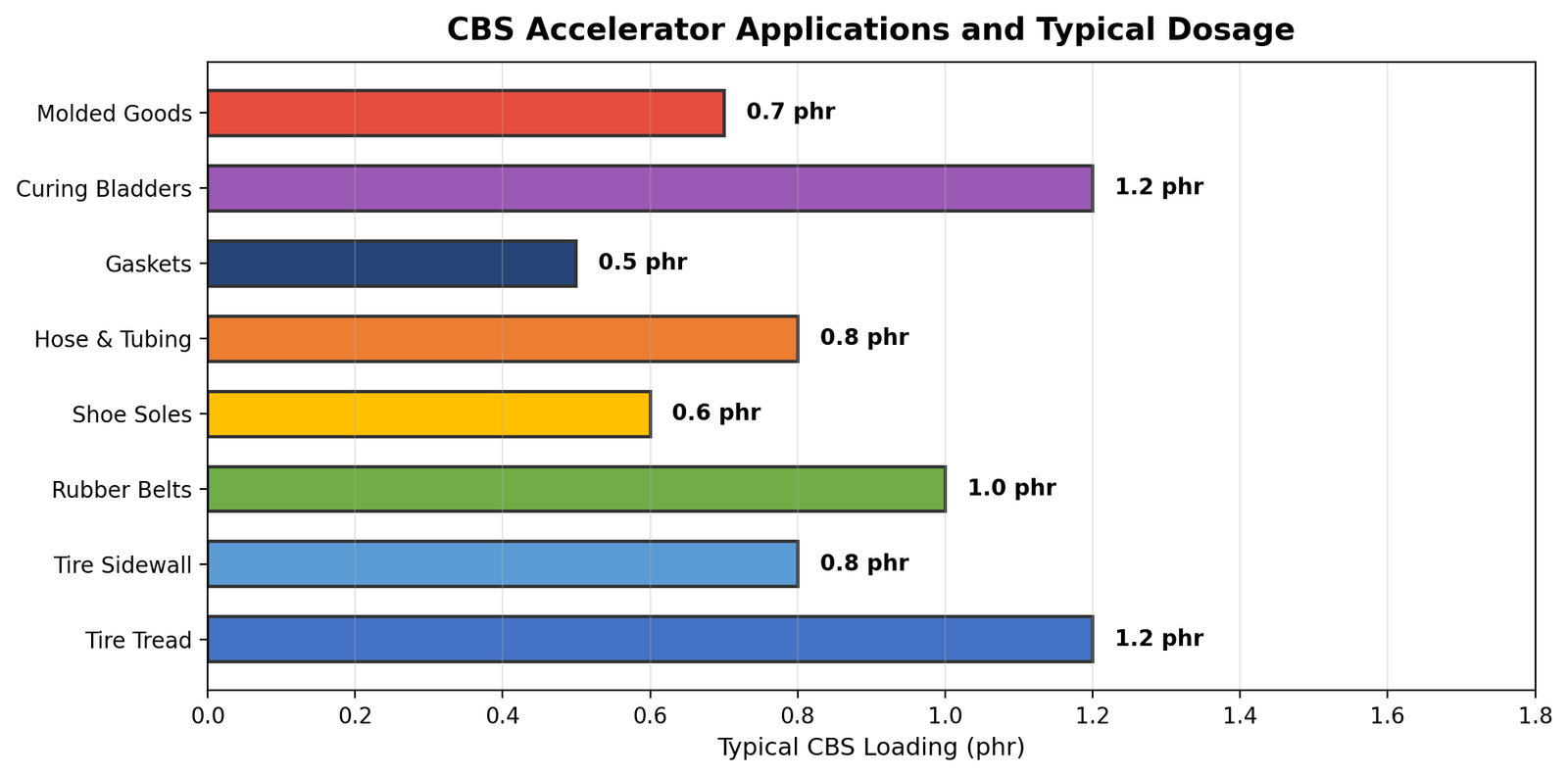
| Tire | Passenger tire tread, truck tire tread, sidewall | 0.8–1.5 | Excellent scorch safety; high modulus |
| Automotive | Engine mounts, bushings, weather seals | 0.5–1.2 | Good dynamic properties |
| Industrial | Conveyor belts, hoses, gaskets | 0.6–1.2 | Balanced cure and safety |
| Footwear | Shoe soles, rubber boots | 0.5–1.0 | Fast cure at moderate temp |
| Molded Goods | Rubber mats, industrial rollers | 0.4–1.0 | Consistent cure throughout thick sections |
| Cable | Wire and cable insulation | 0.5–1.2 | Good electrical properties |
How Does CBS Work in Vulcanization?
CBS is a delayed-action accelerator with a unique two-stage mechanism:
Stage 1: Induction (Scorch Delay)
CBS first decomposes to release 2-mercaptobenzothiazole (MBT) and cyclohexylamine. This decomposition is slow at processing temperatures (below 120°C), providing excellent scorch safety.
Stage 2: Accelerated Cure
Once the temperature reaches vulcanization range (140–160°C), the released MBT rapidly activates sulfur, forming cross-links between rubber polymer chains.
Performance Characteristics
| Parameter | Value |
|---|---|
| Cure speed | Fast |
| Optimal cure temperature | 140–160°C (284–320°F) |
| Scorch time at 121°C (t₅) | 20–35 minutes |
| Mooney scorch (MS at 121°C) | Excellent (slow onset) |
| Cross-link density | High |
| Modulus | High |
| Reversion resistance | Good |
CBS is often combined with secondary accelerators (DPG, TMTD, ZDEC) to fine-tune the cure characteristics for specific applications.
CBS Chemical & Physical Properties
Identifiers
| Identifier | Value |
|---|---|
| CAS Number | 95-33-0 |
| IUPAC Name | N-Cyclohexyl-1,3-benzothiazole-2-sulfenamide |
| Molecular Formula | C₁₃H₁₆N₂S₂ |
| Molecular Weight | 264.41 g/mol |
| EINECS | 202-411-2 |
| RTECS | DL3850000 |
| HS Code | 2934.20 (Heterocyclic compounds) |
Physical Properties
| Property | Value |
|---|---|
| Appearance | White to light gray powder or granules |
| Odor | Slight, characteristic |
| Melting Point | 95–102°C |
| Specific Gravity | 1.27 g/cm³ at 20°C |
| Bulk Density (powder) | 0.40–0.60 g/cm³ |
| Solubility in Water | Insoluble |
| Solubility (organic) | Soluble in acetone, benzene, ethyl acetate, chloroform |
| Flash Point | > 200°C |
| Storage Stability | Min. 24 months (proper conditions) |
How is CBS Manufactured?
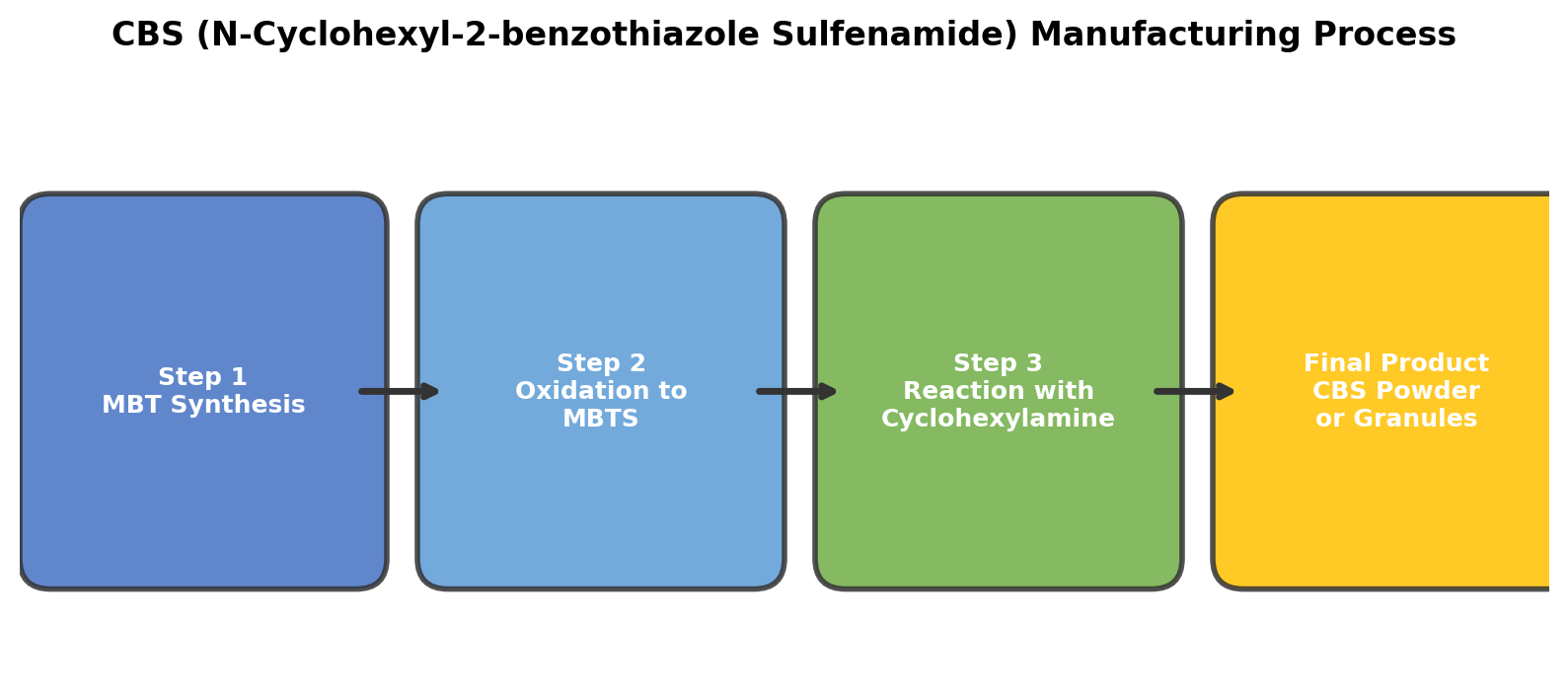
CBS is produced through a two-step process:
Step 1: MBT Synthesis — Aniline, carbon disulfide, and sulfur react under pressure to form 2-mercaptobenzothiazole (MBT).
Step 2: Oxidation with Cyclohexylamine — MBT is oxidized (using sodium hypochlorite or hydrogen peroxide) in the presence of cyclohexylamine to form CBS:
MBT + Cyclohexylamine + [O] → CBS + H₂O
Typical Quality Control Parameters
| Parameter | Specification |
|---|---|
| Purity (HPLC) | ≥ 97% |
| Melting point | 95–102°C |
| Moisture | ≤ 0.5% |
| Ash content | ≤ 0.3% |
| MBT content (free) | ≤ 1.0% |
| pH (10% suspension) | 6.5–8.5 |
CBS vs Other Sulfenamide Accelerators
CBS vs DCBS vs TBBS
| Parameter | CBS | DCBS | TBBS |
|---|---|---|---|
| Full name | N-Cyclohexyl-BT Sulfenamide | N,N-Dicyclohexyl-BT Sulfenamide | N-tert-Butyl-BT Sulfenamide |
| Cure speed | Fast | Slow | Very Fast |
| Optimal temp | 140–160°C | 150–170°C | 140–160°C |
| Scorch safety | Excellent | Best | Good |
| Rebound resilience | High | Very High | High |
| Tire suitability | Excellent | Moderate | Good |
| Cost | Moderate | Higher | Higher |
Selection Guide:
- CBS — All-round best value; use for most tire and industrial rubber applications
- DCBS — Use when maximum scorch safety is needed (thick sections, high-temperature mixing)
- TBBS — Use when faster cure is needed without sacrificing too much scorch safety
CBS Dosage & Formulation Guide
Typical Tire Tread Formulation
| Ingredient | phr |
|---|---|
| Natural rubber (SMR 20) | 100.0 |
| Carbon black (N330) | 45–55 |
| Aromatic oil | 5–10 |
| Zinc oxide | 3–5 |
| Stearic acid | 1–3 |
| CBS | 0.8–1.5 |
| Sulfur | 2.0–2.5 |
| Antioxidant (6PPD) | 1.0–2.0 |
| Wax | 1.0–1.5 |
Synergistic Accelerator Systems
| System | Composition (phr) | Best For | Benefit |
|---|---|---|---|
| CBS + DPG | 0.8–1.2 + 0.2–0.4 | Tire tread, industrial | Balanced cure; improved modulus |
| CBS + TMTD | 0.8–1.0 + 0.1–0.2 | NR molded goods | Faster cure; higher cross-link density |
| CBS + ZDEC | 0.8–1.0 + 0.2–0.3 | Thin-walled goods | Improved cure initiation |
| CBS + MBTS | 0.6–1.0 + 0.3–0.6 | General rubber goods | Cost-effective system |
Dosage by Application
| Application | Recommended CBS (phr) |
|---|---|
| Tire tread (passenger) | 0.8–1.5 |
| Tire tread (truck/bus) | 0.8–1.2 |
| Conveyor belts | 0.6–1.2 |
| Hoses | 0.5–1.0 |
| Shoe soles | 0.5–1.0 |
| Molded goods | 0.4–1.0 |
| Cable insulation | 0.5–1.2 |
Advantages & Limitations of CBS
Advantages ✅
| Advantage | Why It Matters |
|---|---|
| Excellent scorch safety | Safe processing at mixing temperatures |
| Fast cure at vulcanization temp | High productivity |
| High modulus | Strong end products |
| Good reversion resistance | Durable in high-temperature service |
| Compatible with NR, SBR, BR, NBR | Versatile across rubber types |
| Cost-effective | Best value among sulfenamides |
Limitations ❌
| Limitation | Mitigation |
|---|---|
| Not suitable for very high temp cure | Switch to DCBS |
| Moderate nitrosamine concern | Use with nitrosamine scavengers |
| Requires activators (ZnO, stearic acid) | Standard formulation practice |
| Can bloom in high dosage | Keep below 1.5 phr |
CBS Safety & Handling
GHS Classification
| Classification | Detail |
|---|---|
| Signal word | Warning |
| Hazard statements | H317 (Allergic skin reaction), H319 (Eye irritation), H335 (Respiratory irritation) |
Required PPE
| Activity | PPE |
|---|---|
| Handling powder | Safety goggles, N95 respirator, nitrile gloves |
| Handling granules | Safety goggles, nitrile gloves |
| Bulk processing | Full-face respirator, chemical-resistant suit |
First Aid
| Scenario | Action |
|---|---|
| Inhalation | Move to fresh air |
| Skin contact | Wash with soap and water for 15+ minutes |
| Eye contact | Flush with water for 15+ minutes; seek medical attention |
| Ingestion | Do NOT induce vomiting; seek medical help |
Fire Fighting
- Suitable media: Dry powder, foam, CO₂, water spray
- Avoid: Direct water jet
- UN Number: UN3077 (Environmentally hazardous substance, solid, n.o.s.)
- Class: 9 / Packing Group III
CBS Storage & Shelf Life
| Parameter | Specification |
|---|---|
| Temperature | Below 30°C (86°F) |
| Humidity | Below 60% RH |
| Container | Sealed, original packaging |
| Shelf life | 24 months (standard) |
Signs of Degradation
- Color darkening (white → gray → brown)
- Formation of lumps
- Strong amine odor
- Reduced scorch safety
- Lower melting point
CBS Regulatory Compliance
| Certification | Status |
|---|---|
| ISO 9001 | Standard |
| REACH (EU) | ✓ Available |
| TSCA (USA) | ✓ Listed |
| SGS test report | Upon request |
| FDA (food contact) | Limited applications |
Nitrosamine Considerations
CBS can form NDPA (N-Nitrosodiphenylamine) in trace amounts under certain conditions. Current EU regulations allow CBS use within specified limits. The industry trend is toward low-nitrosamine grades and optimized formulations.
CBS Packaging & Shipping
Packaging Options
| Type | Weight |
|---|---|
| PP woven bag + PE liner | 20 kg |
| Paper bag + PE liner | 20 kg |
| Fiber drum | 25 kg |
| FIBC big bag | 500–1000 kg |
Shipping Classification
| Mode | Detail |
|---|---|
| UN Number | 3077 |
| Class | 9 |
| Packing group | III |
CBS Price Factors & Market Trends (2026)
What Affects CBS Pricing
| Factor | Impact |
|---|---|
| Aniline cost | High |
| Carbon disulfide cost | High |
| Cyclohexylamine cost | Medium |
| China production capacity | High (70%+ of global) |
Estimated Price Range (2026, FOB China)
| Grade | USD/kg |
|---|---|
| CBS powder (standard) | $2.20–$3.50 |
| CBS granules (dust-free) | $2.50–$3.80 |
Key Market Trends 2024–2026
- Stable demand from tire industry — CBS remains the preferred sulfenamide for tire manufacturing
- Chinese capacity expansion — New production lines stabilizing global supply
- Low-nitrosamine grades gaining traction — Regulatory pressure driving special grades
- Raw material volatility — Aniline prices tied to benzene and oil markets
Frequently Asked Questions About CBS
What is the difference between CBS and TBBS?
CBS (cyclohexyl group) offers better scorch safety; TBBS (tert-butyl group) cures faster. CBS is more cost-effective and widely used.
Can CBS be used in latex?
CBS is not typically used in latex dipping. It is designed for dry rubber compounds. Use ZDEC or ZMBT for latex applications.
What is the cure temperature for CBS?
140–160°C (284–320°F). The optimal range depends on the specific compound formulation.
Does CBS expire?
Yes. CBS has a shelf life of 24 months when stored properly. Degraded CBS loses scorch safety and cure efficiency.
Is CBS the same as MBTS?
No. CBS is a sulfenamide; MBTS is a thiazole. CBS has superior scorch safety and is preferred for tire manufacturing.
Where to Buy CBS?
Rayway Chemical (raywaychem.com) supplies high-quality CBS and other sulfenamide accelerators.
| Why Rayway Chemical? | Details |
|---|---|
| ✅ ISO 9001 certified | Quality management system |
| ✅ REACH compliant | EU registration available |
| ✅ SGS testing | Upon request |
| ✅ Multiple grades | Powder, granules, oil-treated |
| ✅ Flexible packaging | 20 kg to 1000 kg |
| ✅ Global shipping | FOB Qingdao / CIF worldwide |
| ✅ Free samples | Available for qualified partners |
Contact Rayway Chemical → for pricing, samples, and technical documentation.
Last updated: May 2026. Specifications subject to change. Contact Rayway Chemical for current data sheets.

