
ZDBC Rubber Accelerator: The Complete 2026 Guide to Zinc Dibutyl Dithiocarbamate
ZDBC (Zinc Dibutyl Dithiocarbamate) is a fast-curing rubber accelerator in the dithiocarbamate family, widely used in tire manufacturing, industrial rubber goods, and dark-colored rubber products. It offers better scorch safety than ZDEC while maintaining a fast cure rate, making it the preferred choice for tire compounds and high-temperature vulcanization.
What is ZDBC?
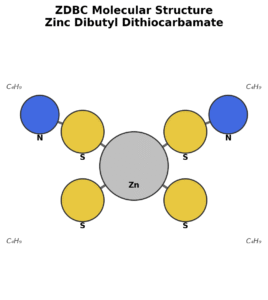
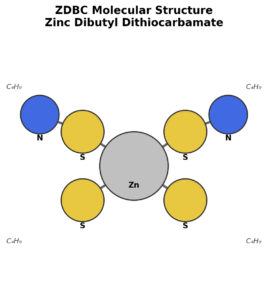
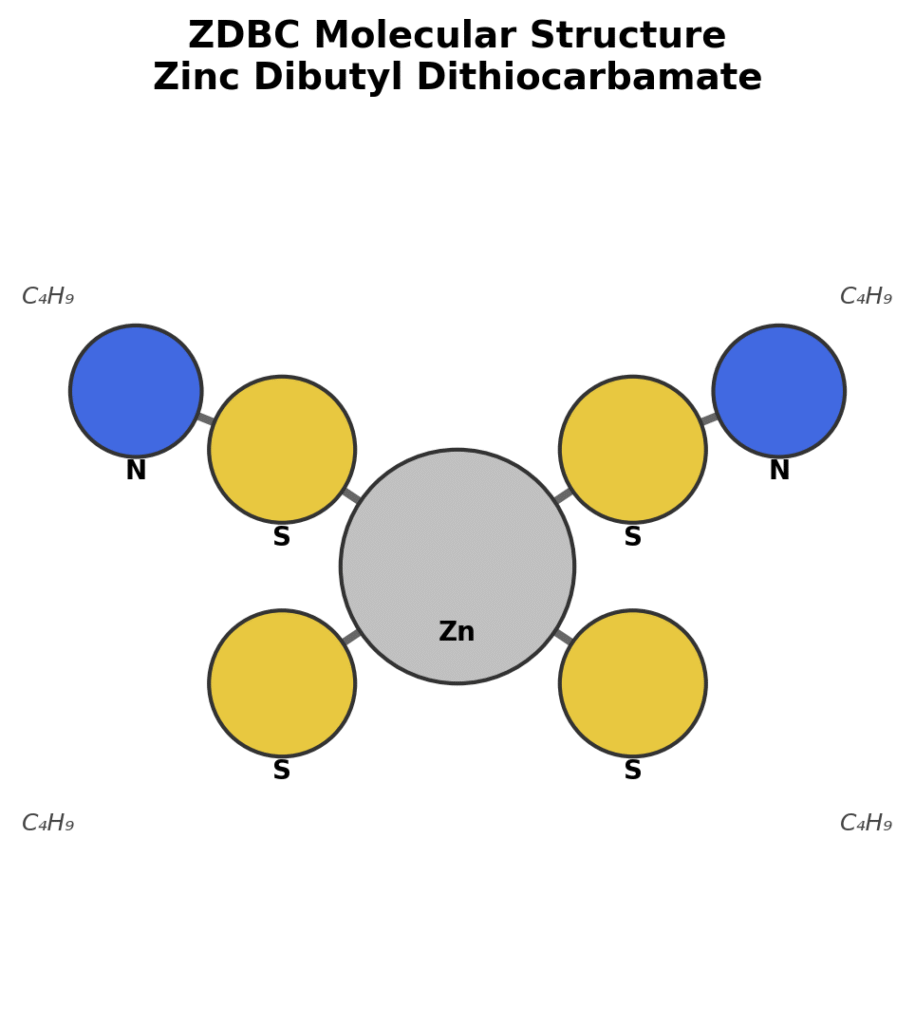
ZDBC stands for Zinc Dibutyl Dithiocarbamate. It is a fast-curing primary and secondary accelerator belonging to the dithiocarbamate class. Compared to ZDEC, ZDBC has longer alkyl chains (butyl vs ethyl) which gives it better scorch safety and heat resistance, making it ideal for tire manufacturing and darker rubber goods.
Common names:
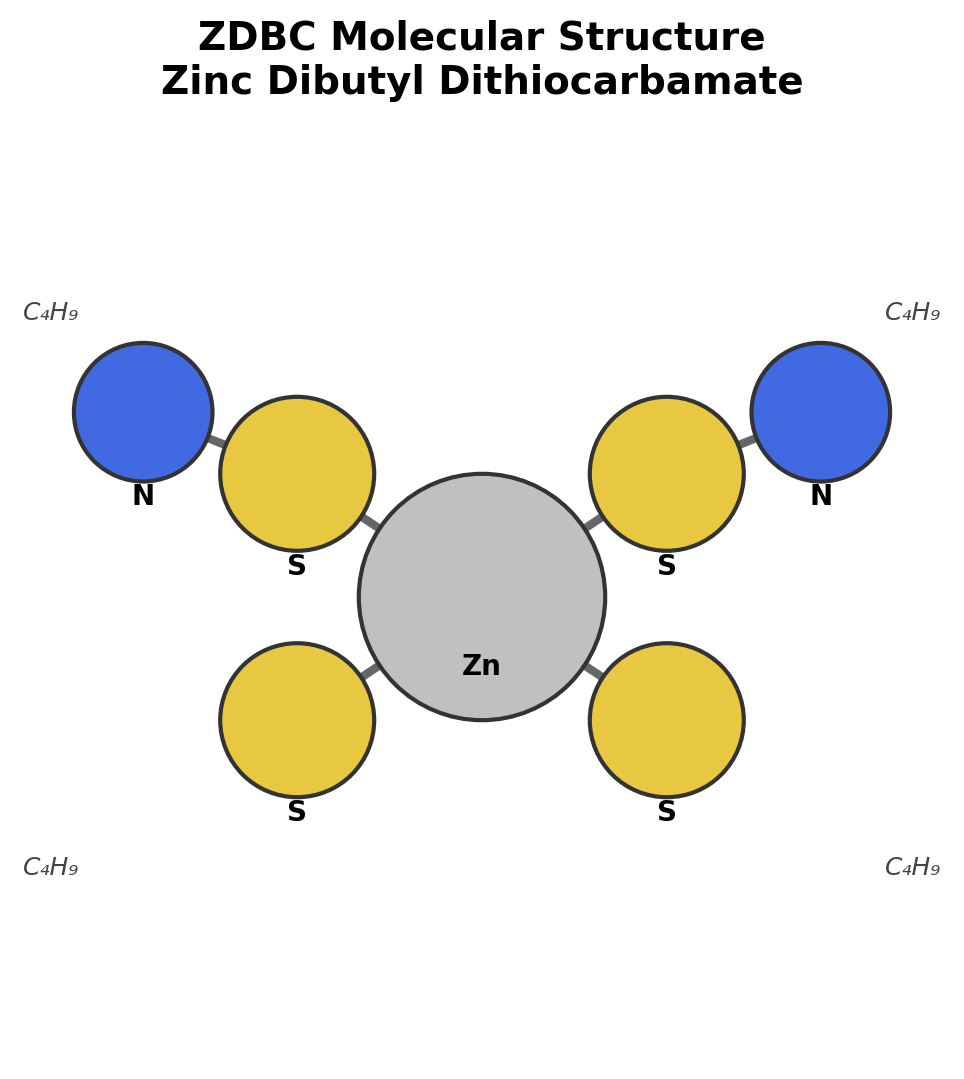
ZDBC, Zinc Dibutyl Dithiocarbamate, Butyl Zimate, Zinc DBDC
Quick Facts
| Property | Value |
|---|---|
| Chemical Name | Zinc Dibutyl Dithiocarbamate |
| CAS Number | 136-23-2 |
| Molecular Formula | C₁₈H₃₆N₂S₄Zn |
| Molecular Weight | 474.12 g/mol |
| Appearance | White to cream powder or granules |
| Melting Point | 104–110°C |
| HS Code | 2930.20 |
| EINECS Number | 205-232-8 |
What is ZDBC Used For?
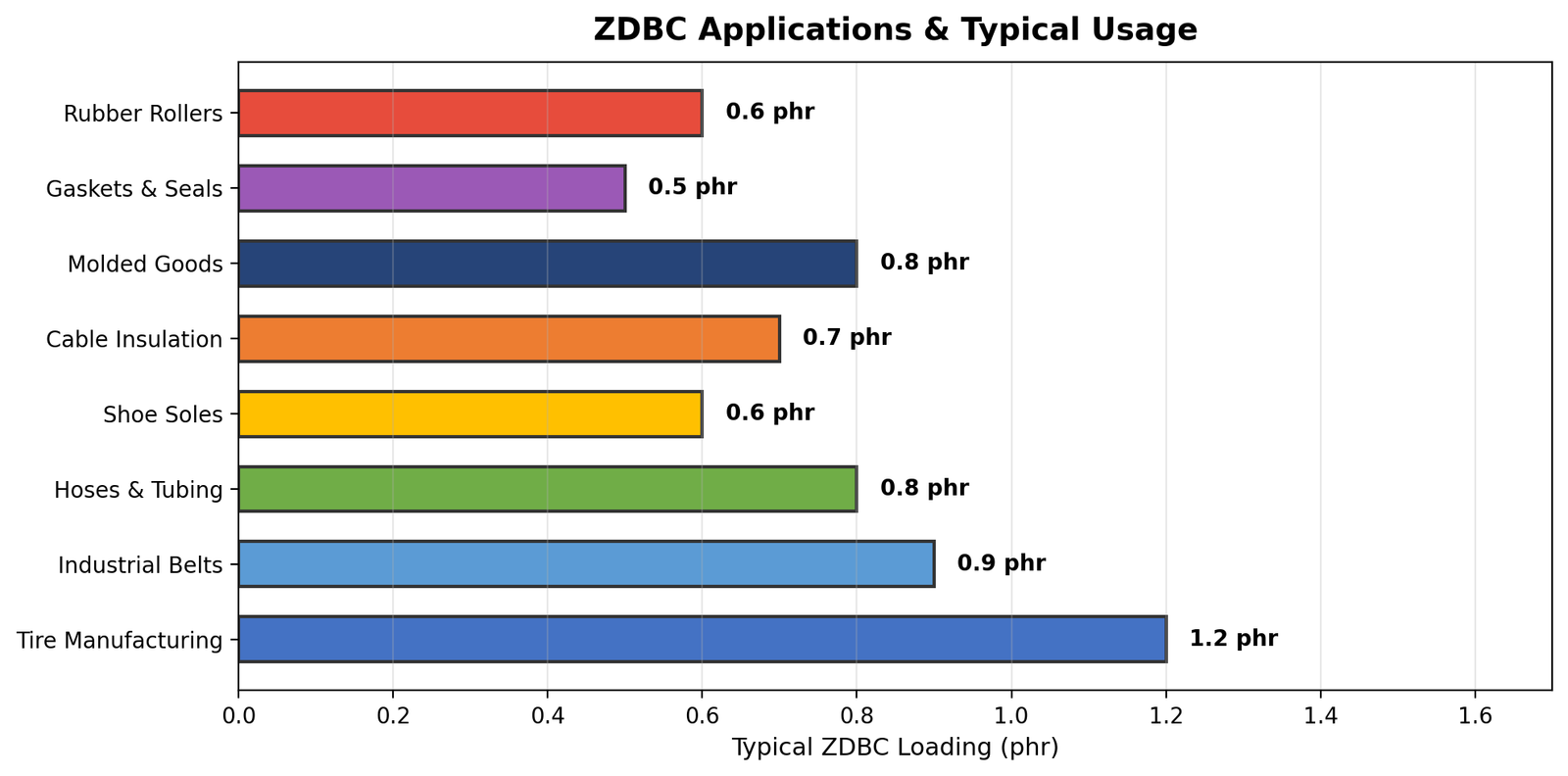
ZDBC is used as a fast-curing accelerator in sulfur vulcanization, with strong adoption in tire manufacturing and industrial rubber goods. Its butyl groups provide better heat resistance and scorch safety compared to ZDEC.
Primary Applications
| Industry | Product Examples | Typical ZDBC Loading (phr) | Key Benefit |
|---|---|---|---|
| Tire | Truck tire tread, passenger tire, retread compounds | 0.5–1.5 | Excellent heat resistance; good scorch safety |
| Automotive | Engine mounts, bushings, suspension components | 0.4–1.2 | High durability under dynamic stress |
| Industrial | Conveyor belts, hoses, transmission belts | 0.5–1.0 | Good aging resistance |
| Footwear | Rubber soles, boots | 0.3–0.8 | Controllable cure rate |
| Cable | Wire insulation, cable sheathing | 0.4–1.0 | Good electrical properties |
| Molded Goods | Industrial rollers, gaskets, seals | 0.3–1.0 | Consistent cure in thick sections |
How Does ZDBC Work in Vulcanization?
ZDBC functions through the same dithiocarbamate mechanism as ZDEC, but its butyl groups introduce important differences:
- Activation: ZDBC reacts with zinc oxide and stearic acid to form a soluble zinc complex
- Sulfur activation: The complex breaks sulfur rings into reactive polysulfide chains
- Cross-link formation: Creates C-S-C bonds between rubber polymer chains
- Catalytic regeneration: ZDBC is regenerated to continue the process
Performance Characteristics
| Parameter | Value |
|---|---|
| Cure speed | Fast |
| Optimal cure temperature | 110–150°C (230–302°F) |
| Scorch time at 120°C | 5–10 minutes |
| Cross-link density | High |
| Scorch safety | Good (better than ZDEC) |
| Heat resistance | Good |
Key difference from ZDEC: ZDBC's butyl chains provide steric hindrance that slows the onset of vulcanization, giving better scorch safety while maintaining a fast overall cure rate.
ZDBC Chemical & Physical Properties
Identifiers
| Identifier | Value |
|---|---|
| CAS Number | 136-23-2 |
| IUPAC Name | Zinc bis(dibutylcarbamodithioate) |
| Molecular Formula | C₁₈H₃₆N₂S₄Zn |
| Molecular Weight | 474.12 g/mol |
| EINECS | 205-232-8 |
| RTECS | ZH0350000 |
| HS Code | 2930.20 (Organo-sulfur compounds) |
Physical Properties
| Property | Value |
|---|---|
| Appearance | White to cream powder or granules |
| Odor | Slight, characteristic amine odor |
| Melting Point | 104–110°C |
| Specific Gravity | 1.24 g/cm³ at 20°C |
| Bulk Density (powder) | 0.35–0.55 g/cm³ |
| Solubility in Water | Insoluble |
| Solubility (organic) | Chloroform, benzene, acetone, carbon disulfide |
| Flash Point | > 100°C |
| Storage Stability | Min. 24 months |
How is ZDBC Manufactured?
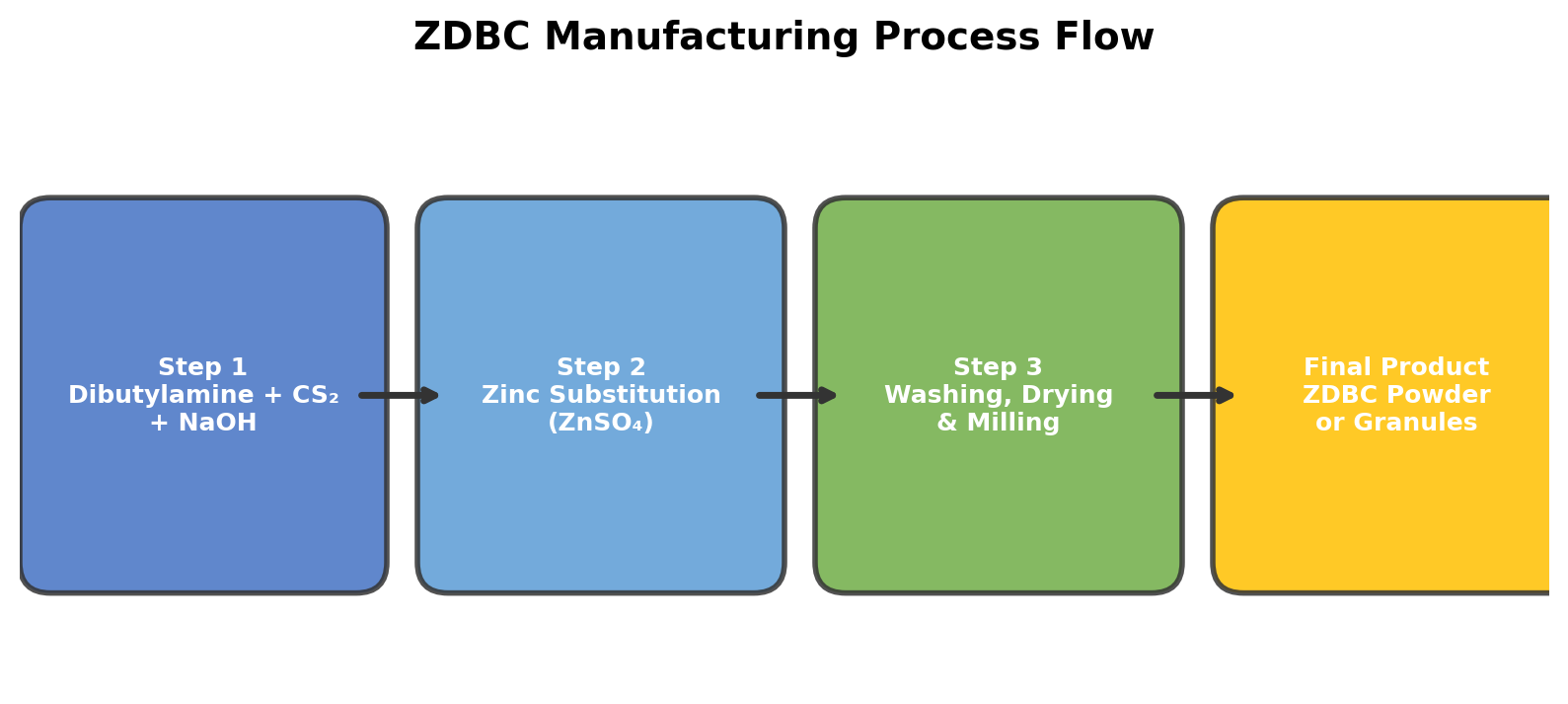
ZDBC is produced through a similar process to ZDEC, using dibutylamine instead of diethylamine:
Step 1: Dibutylamine reacts with carbon disulfide and sodium hydroxide to form sodium dibutyl dithiocarbamate:
(C₄H₉)₂NH + CS₂ + NaOH → (C₄H₉)₂N-CS₂Na + H₂O
Step 2: The sodium salt is reacted with zinc sulfate to precipitate ZDBC:
2(C₄H₉)₂N-CS₂Na + ZnSO₄ → [(C₄H₉)₂N-CS₂]₂Zn + Na₂SO₄
Step 3: The precipitate is washed, dried at 50–60°C, and milled or granulated.
Quality Control Parameters
| Parameter | Specification |
|---|---|
| Purity (HPLC) | ≥ 97% |
| Zinc content | 13.0–14.5% |
| Moisture | ≤ 0.5% |
| Melting point | 104–110°C |
| Ash content | ≤ 0.3% |
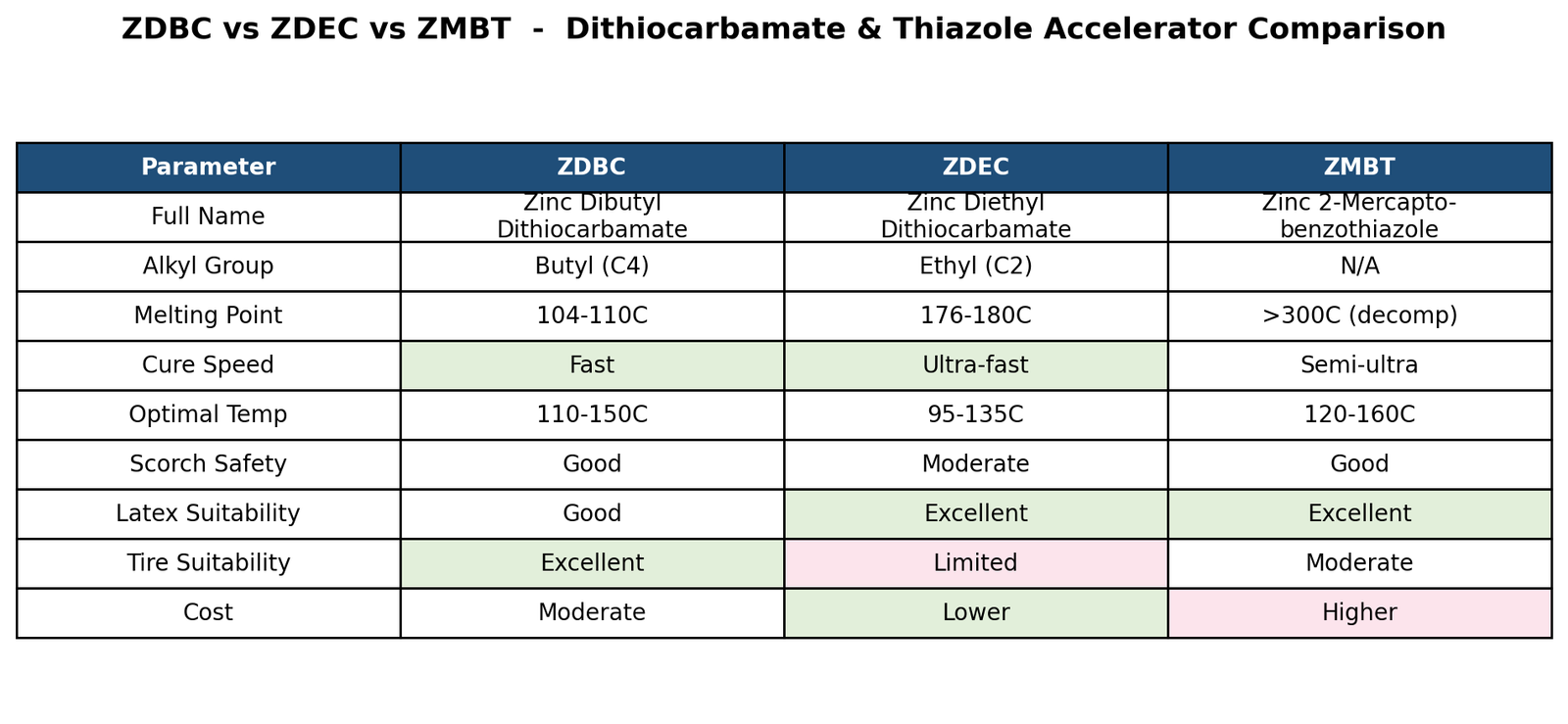
ZDBC vs ZDEC vs ZMBT
| Parameter | ZDBC | ZDEC | ZMBT |
|---|---|---|---|
| Full name | Zinc Dibutyl Dithiocarbamate | Zinc Diethyl Dithiocarbamate | Zinc 2-Mercaptobenzothiazole |
| Alkyl group | Butyl (C₄) | Ethyl (C₂) | N/A |
| Melting point | 104–110°C | 176–180°C | >300°C (decomp) |
| Cure speed | Fast | Ultra-fast | Semi-ultra |
| Optimal temp | 110–150°C | 95–135°C | 120–160°C |
| Scorch safety | Good | Moderate | Good |
| Latex suitability | Good | Excellent | Excellent |
| Tire suitability | Excellent | Limited | Moderate |
| Cost | Moderate | Lower | Higher |
Selection Guide:
- ZDBC — Best for tire compounds, dark-colored goods, high-temperature vulcanization
- ZDEC — Best for latex dipping, low-temperature cure, fast production cycles
- ZMBT — Best for latex and NR goods requiring good scorch safety
ZDBC Dosage & Formulation Guide
Typical Truck Tire Tread Formulation
| Ingredient | phr |
|---|---|
| Natural rubber (SMR 20) | 70.0 |
| Butadiene rubber (BR) | 30.0 |
| Carbon black (N330) | 50–60 |
| Aromatic oil | 5–8 |
| Zinc oxide | 3–5 |
| Stearic acid | 1–3 |
| ZDBC | 0.8–1.2 |
| CBS | 0.5–0.8 |
| Sulfur | 2.0–2.5 |
| Antioxidant (6PPD) | 1.0–2.0 |
Synergistic Accelerator Systems
| System | Composition (phr) | Best For | Benefit |
|---|---|---|---|
| ZDBC + CBS | 0.3–0.5 + 0.8–1.2 | Tire compounds | Balanced cure + good scorch |
| ZDBC + TMTD | 0.3–0.5 + 0.2–0.3 | NR/SBR blends | Faster initiation |
| ZDBC + DPG | 0.5 + 0.3–0.5 | Dark molded goods | Higher cross-link density |
| ZDBC + ZDEC | 0.3 + 0.3 | General rubber | Balanced cost and performance |
Dosage by Application
| Application | Recommended ZDBC (phr) |
|---|---|
| Tire tread (truck) | 0.8–1.5 |
| Tire tread (passenger) | 0.5–1.0 |
| Conveyor belts | 0.5–1.0 |
| Industrial hoses | 0.4–0.8 |
| Shoe soles | 0.3–0.8 |
| Molded goods | 0.3–1.0 |
| Cable insulation | 0.4–1.0 |
Advantages & Limitations of ZDBC
Advantages ✅
| Advantage | Why It Matters |
|---|---|
| Good scorch safety | Safe processing, less scrap |
| Fast cure rate | Good productivity |
| Excellent heat resistance | Suitable for high-temp applications |
| Good tire compatibility | Preferred for tread compounds |
| Cost-effective | Good value vs performance |
| Low blooming | Suitable for dark-colored goods |
Limitations ❌
| Limitation | Mitigation |
|---|---|
| Not for low-temp latex | Use ZDEC or ZMBT for latex |
| Not for light-colored goods | Slight discoloration |
| Moderate nitrosamine potential | Use nitrosamine scavengers |
| Higher cost than ZDEC | Use in combination with lower-cost accelerators |
ZDBC Safety & Handling
GHS Classification
| Classification | Detail |
|---|---|
| Signal word | Warning |
| Hazard statements | H302 (Harmful if swallowed), H315 (Skin irritation), H319 (Eye irritation), H317 (Allergic skin reaction), H335 (Respiratory irritation) |
Required PPE
| Activity | PPE |
|---|---|
| Handling powder | Safety goggles, N95 respirator, nitrile gloves |
| Handling granules | Safety goggles, nitrile gloves |
| Bulk processing | Full-face respirator, chemical-resistant suit |
First Aid
| Scenario | Action |
|---|---|
| Inhalation | Move to fresh air |
| Skin contact | Wash with soap and water for 15+ minutes |
| Eye contact | Flush with water for 15+ minutes; seek medical attention |
| Ingestion | Do NOT induce vomiting; seek medical help |
Fire Fighting
- Suitable media: Dry powder, foam, CO₂, water spray
- UN Number: UN3077 (Environmentally hazardous substance, solid, n.o.s.)
- Class: 9 / Packing Group III
ZDBC Storage & Shelf Life
| Parameter | Specification |
|---|---|
| Temperature | Below 30°C (86°F) |
| Humidity | Below 60% RH |
| Container | Sealed, original packaging |
| Shelf life | 24 months (standard) |
Signs of Degradation
- Color darkening (cream → yellow → brown)
- Lumping or caking
- Strong amine odor
- Reduced cure activity
- Lower melting point
ZDBC Regulatory Compliance
| Certification | Status |
|---|---|
| ISO 9001 | Standard |
| REACH (EU) | ✓ Available |
| TSCA (USA) | ✓ Listed |
| SGS test report | Upon request |
| K-REACH (Korea) | Pre-registration |
Nitrosamine Compliance
ZDBC can form NDBA (N-Nitrosodibutylamine) under certain conditions. The risk is moderate — higher than ZDEC but lower than thiuram accelerators. Use within recommended limits and with nitrosamine scavengers for sensitive applications.
ZDBC Packaging & Shipping
Packaging Options
| Type | Weight |
|---|---|
| PP woven bag + PE liner | 20 kg |
| Paper bag + PE liner | 20 kg |
| Fiber drum | 25 kg |
| FIBC big bag | 500–1000 kg |
Shipping Classification
| Mode | Detail |
|---|---|
| UN Number | 3077 |
| Class | 9 |
| Packing group | III |
ZDBC Price Factors & Market Trends (2026)
What Affects ZDBC Pricing
| Factor | Impact |
|---|---|
| Dibutylamine cost | High (key raw material) |
| Carbon disulfide cost | High |
| Zinc metal price | Medium |
| China production | High (70%+ global) |
Estimated Price Range (2026, FOB China)
| Grade | USD/kg |
|---|---|
| ZDBC powder (standard) | $3.00–$4.50 |
| ZDBC granules (dust-free) | $3.30–$4.80 |
| ZDBC oil-treated | $3.50–$5.00 |
Key Market Trends 2024–2026
- Steady tire industry demand — ZDBC remains a key accelerator for tire manufacturing
- Cost pressure from dibutylamine — Raw material prices tied to butanol and ammonia markets
- Shift toward safer alternatives — Nitrosamine regulations driving formulation optimization
- China capacity expansion — New production lines in Shandong stabilizing supply
Frequently Asked Questions About ZDBC
What is the difference between ZDBC and ZDEC?
ZDBC has butyl groups (C₄), ZDEC has ethyl groups (C₂). ZDBC offers better scorch safety and heat resistance; ZDEC cures faster at lower temperatures.
Is ZDBC suitable for latex?
ZDBC can be used in latex but ZDEC is preferred due to ZDEC's better low-temperature activity and dispersion.
What is the cure temperature for ZDBC?
110–150°C (230–302°F), higher than ZDEC's 95–135°C range.
Is ZDBC banned under REACH?
No. ZDBC is REACH-registered and compliant for approved applications.
Can ZDBC be used with natural rubber?
Yes. ZDBC is highly compatible with NR, SBR, BR, NBR, and EPDM.
Where to Buy ZDBC?
Rayway Chemical (raywaychem.com) supplies high-quality ZDBC and other dithiocarbamate accelerators.
| Why Rayway Chemical? | Details |
|---|---|
| ✅ ISO 9001 certified | Quality management system |
| ✅ REACH compliant | EU registration available |
| ✅ SGS testing | Upon request |
| ✅ Multiple grades | Powder, granules, oil-treated |
| ✅ Global shipping | FOB Qingdao / CIF worldwide |
| ✅ Free samples | For qualified partners |
Contact Rayway Chemical → for pricing, samples, and technical documentation.
Last updated: May 2026. Specifications subject to change.